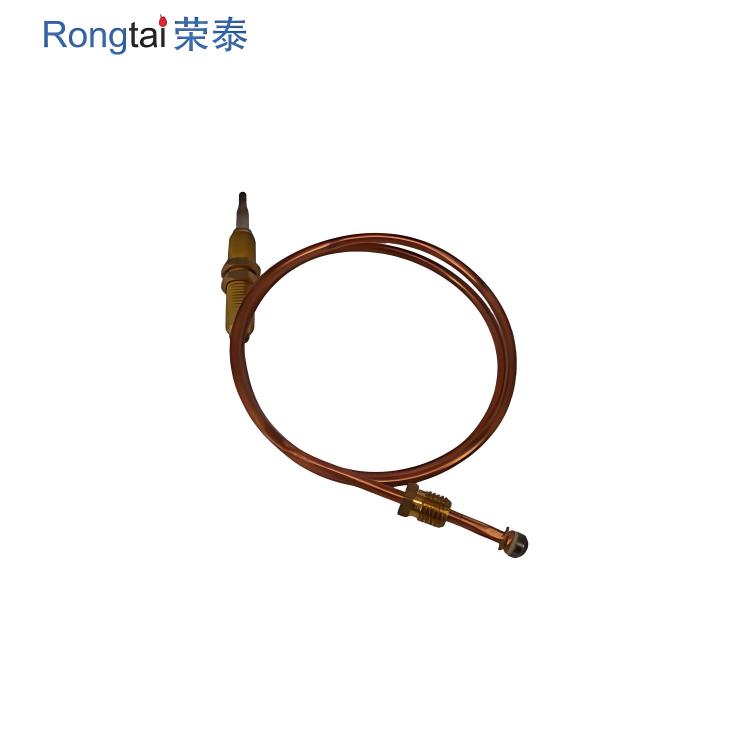
A standard burner thermocouple sits right beside the flame on a stovetop. It sees maybe 500°F at most, with occasional grease splatter and spilled sauce. Manufacturers use basic chromel-alumel wires with a thin stainless steel sheath. That works fine for simmering soup. But inside an oven, things get brutal. Self-cleaning cycles blast past 900°F. Roasting a turkey means hours of sustained heat, plus moisture and acidic vapors from fats. That environment eats standard sensors alive.
To survive that torture, an oven thermocouple gets the heavy-duty treatment. Heavier-gauge wires. A thick Inconel or 310 stainless jacket. Ceramic-packed insulation that shrugs off thermal shock. The welded junction is reinforced against oxidation because at 1000°F, even air becomes corrosive. That extra bulk is not just for show—it slows down heat penetration and gives the metals room to expand without cracking. That is why it outlasts the burner sensor by years.
Now throw in the ignition dance. Most ovens rely on a Hot Surface Igniter—a silicon carbide rod that glows blinding orange to light the gas. That igniter draws serious current and radiates intense heat toward the burner tube. And guess what gets baked by that radiant blast? The very same thermocouple, sitting just a few inches away. So your oven thermocouple does not just endure flame heat; it also endures the glow from that igniter every single time the oven cycles on. Standard burner sensors never face that double punch—they only handle the flame itself.
Meanwhile, a cooktop usually uses a spark igniter—a quick zap of high-voltage electricity that fires for half a second and stops. That spark igniter is a brief visitor. But the Hot Surface Igniter stays hot for 30 to 60 seconds per ignition cycle, pumping infrared energy into the cavity. The oven thermocouple sits there, baking and cooling, baking and cooling, thousands of times over its lifetime. That relentless thermal cycling is what kills lesser sensors. But the oven-grade thermocouple is built with thicker walls and purer alloys precisely to handle that punishing rhythm.
So the next time you preheat your oven and hear that quiet click of the gas valve holding open, remember: the tough little thermocouple behind that click is not the same as the one on your stovetop. One works in a mild climate; the other works in a furnace. And when it stands shoulder to shoulder with a glowing Hot Surface Igniter day after day, you realize that extra metal and ceramic insulation are not overkill—they are survival gear. That is why your oven keeps lighting long after the burner sensor has gone to the trash.