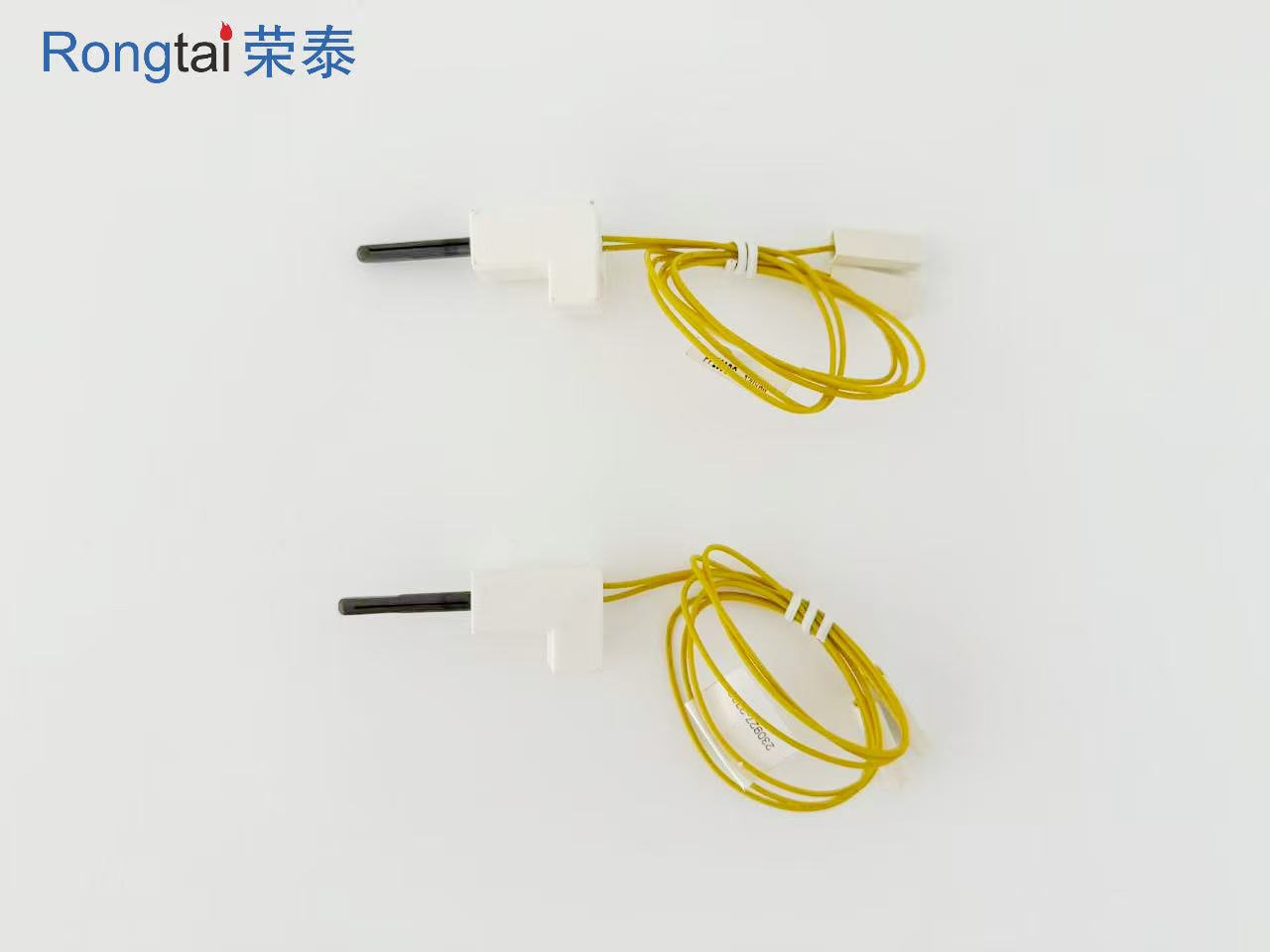
For industrial boiler operators, few things are more frustrating than a failed startup. A boiler that refuses to light means lost production, emergency callouts, and hours of downtime. Traditional metal ignition pins—typically fabricated from stainless steel or brass—have long been the weak link in this equation. Their limitations are well documented: long-term temperature resistance capped at 600°C, susceptibility to cracking under thermal shock, corrosion from flue gases, and scaling that gradually degrades ignition performance. In humid or dusty environments, these metal pins frequently fail to generate a reliable spark, with ignition success rates hovering around 85%.
Enter the silicon nitride hot surface igniter. Constructed from silicon nitride ceramic (Si₃N₄)—a material with hardness second only to diamond—these igniters operate on a fundamentally different principle. Rather than relying on high-voltage sparks that can be disrupted by moisture or contamination, they rapidly heat a ceramic surface to the fuel's ignition point—typically between 300°C and 800°C. The result is ignition that is unaffected by humidity, oil contamination, or environmental interference.
The performance gap is stark. Where a traditional silicon carbide igniter offers fracture toughness of approximately 3-4 MPa·m¹/², silicon nitride delivers 6-7 MPa·m¹/²—providing significantly greater resistance to thermal shock and mechanical stress. Silicon nitride igniters can operate reliably between -40°C and 1300°C, ensuring consistent ignition even in winter conditions. Their service life extends to 8,000-12,000 hours, compared to just 2,000-3,000 hours for metal pins—translating to replacement every 2-3 years rather than every 3-6 months.
A chemical processing facility offers a compelling case study. After replacing traditional ignition needles with silicon nitride hot surface igniters, the boiler startup success rate jumped from 85% to 100%. The replacement cycle extended from once every four months to approximately once every two years. Annual maintenance downtime dropped by roughly 12 hours, and overall operation and maintenance costs decreased by more than 40%. Safety risks associated with corrosion and gas leakage from conventional ignition pins were eliminated entirely.
The market is responding. Silicon nitride igniters now account for 65% of the hot surface igniter market, with the global sector projected to grow from $247 million in 2025 to $383 million by 2031. For boiler operators still relying on outdated ignition technology, the question is no longer whether to upgrade—but how soon.